




Campervan vs Motorhome Hire in Scotland: How to Choose
Key takeaways
If you are starting to plan a Scottish trip on four wheels, the first thing the search results throw at you is a vocabulary problem. Some sites say motorhome. Some say campervan. Some use the two interchangeably. They are not quite the same vehicle, but the line between them is fuzzier than most articles admit, and the practical question for a holiday is rarely which label fits the chassis. It is which layout, which licence, and which size suits the trip you have in mind. Here is the campervan vs motorhome question answered for a Scottish hire.
The short answer
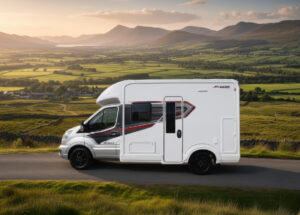
A motorhome is a larger, coachbuilt vehicle with a fully fitted interior: a fixed bed or beds, a proper kitchen, a washroom with a toilet and usually a shower, and standing headroom throughout. The word that causes the confusion is campervan, because it covers two very different vehicles. At one end is the small pop-top camper, a VW California and the like, with a fold-out bed and a little kitchen but no toilet or shower. At the other is the fully-equipped campervan, which packs everything a motorhome has, washroom included, into a more compact, easier-to-drive profile. Atlas hires the fully-equipped kind, not the pop-top kind, so every vehicle in the fleet has a proper toilet and shower whatever it is called. Both run on a standard UK car licence (category B). For most Scottish hire trips the practical difference is space, washroom, and how far off-grid you can go between stops. Atlas’s fleet is built around exactly that: four-berth vehicles from a compact six metres up to around seven and a half, every one with a fixed washroom.
What is a motorhome?
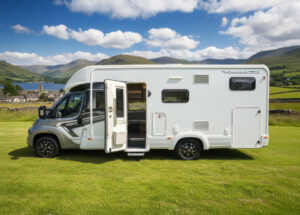
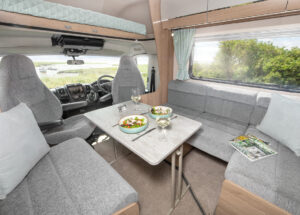
A motorhome is built on a van or light-truck chassis with a coachbuilt body fitted on top. The interior is designed as a home rather than retro-fitted into a panel van. You stand up to cook. You walk through to the rear lounge or the fixed bed. The washroom is a proper compartment with a toilet, a basin, and in most modern layouts a shower. Heating runs off gas or diesel, and a leisure battery, often topped up by solar, keeps the lights and fridge going when you are off hook-up.
The trade-off is size. Four-berth motorhomes commonly run from about six metres up to seven and a half, and a little over three metres tall. The bigger end has the footprint of a small commercial van, and it changes how you drive: more careful on single-track roads, slower into laybys, more deliberate on a ferry slipway. None of it is hard. It is just bigger, and the compact end is barely more vehicle to place than a large estate car.
What is a campervan?
The word campervan does two jobs, and that is the root of the confusion. The classic image is the small camper: a panel van such as a VW Transporter, Transit Custom or California, fitted with a rock-and-roll bed that doubles as the seat, a compact kitchen, and often a pop-top roof for standing room or a child’s bunk. It drives like a car and parks anywhere, but the trade-off is facilities, as most have no indoor toilet or shower and only a small kitchen. They are great for festivals and quick getaways, and they are not what Atlas hires.
The other kind, and the one Atlas does hire, is the fully-equipped campervan. It keeps the compact, easy-to-drive footprint but fits in everything you would want for a longer trip: beds for four, a full kitchen with an oven, and a proper washroom with a toilet and shower. Think of it as a motorhome’s kit in a slightly smaller body. At six metres it is exactly the same length as Atlas’s compact motorhome, so the choice between the two comes down to layout and living space, not what is on board.
How are they actually different?
- Two kinds of campervan. The small pop-top camper (think VW California) has a fold-out bed and a basic kitchen but no washroom; a fully-equipped campervan, like Atlas hires, has the lot. Atlas does not hire the pop-top kind.
- Washroom. Every Atlas vehicle, campervan and motorhome alike, has a fixed toilet and shower. The pop-top campers other firms hire usually have neither.
- Kitchen. Atlas vans have a full kitchen with an oven, hob and fridge; pop-top campers make do with a small unit.
- Beds. Atlas vehicles are four-berth, with a mix of fixed and convertible beds; pop-tops typically sleep two adults with two children up top.
- Size and layout. Atlas’s campervan and compact motorhome are both six metres; the larger motorhomes are coachbuilt and walk-through at around seven and a half, with more living space and a rear lounge or garage.
- Off-grid time. Bigger water tanks, more gas and bigger batteries on the larger motorhomes mean longer between hook-ups.
Do you need a special licence in the UK?
For the vehicles most hire companies offer, no. A standard UK driving licence (category B) covers vehicles up to 3,500kg. Both campervans and the four-berth motorhome layouts in Atlas’s fleet sit inside that limit, so anyone who passed their car test from 1997 onwards can drive them. Larger six-berth and American-style RVs can creep over 3.5 tonnes and need a C1 entitlement, but that is not a category Atlas hires. The full DVLA rules on category B and C1 are on gov.uk’s driving licence categories page.
What about ferries and running costs?
Ferries are where vehicle size shows up most clearly in your budget, so it is worth knowing the threshold before you book. CalMac charges vehicles at or under six metres the standard car rate, while motorhomes over six metres pay a higher rate, with a sharp step up once you pass the 6.1-metre mark (at the time of writing; check the current CalMac vehicle charges for exact fares). Atlas’s compact six-metre motorhome travels at the car rate; the larger seven-and-a-half-metre layouts sit in the dearer band.
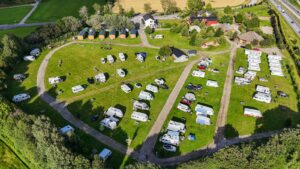
If your trip leans on ferries, a run out to Mull, the crossing to Harris and Lewis, or hopping between the islands, that gap adds up across a fortnight. The compact vehicles also fit more pitches, since plenty of smaller campsites and aires cap vehicle length, and staying under six metres opens up more of them. On fuel, the lighter compact vehicle generally drinks less than the larger one, though both are happy on a long touring run.
Which one is right for a Scotland trip?
It depends on the shape of the trip. A couple doing a fast loop of the Argyll coast, eating out most evenings and sleeping at campsites with full facilities, will be happy at the compact end of the range. A family of four heading up to Skye and Wester Ross for ten days, with one or two long off-grid nights, two children who want their own beds, and a dog that needs space at the end of a wet day, wants the room of a larger motorhome. The same logic holds whether you are touring the NC500 or staying closer to Glasgow.
The other practical factor is the washroom. A fitted toilet and shower is a different proposition at 3am, in a layby, in the rain, than going without, and every Atlas vehicle, the campervan included, has one. For first-time hirers travelling with children, that is usually the deciding line, and it is the main reason Atlas’s fleet looks the way it does.
What Atlas actually hires
Atlas keeps the fleet simple: four-berth vehicles, all under two years old, mostly automatic, every one with a fixed washroom, a proper kitchen, and the kit a Scottish trip actually needs. They range in size from a compact six-metre model up to roomy seven-and-a-half-metre layouts with a fixed bed and a rear lounge.
The compact one is listed as a campervan, and it drives and parks with campervan-like ease, and travels at the car rate on ferries. It is six metres long, exactly the same as the compact motorhome in the fleet, so the two are the same size to drive, park and put on a ferry; the only real difference is the van-style layout of one against the coachbuilt, walk-through layout of the other. The one thing Atlas does not do is the small VW-style camper, the pop-top conversion with a rock-and-roll bed and no washroom that some operators hire out. Every Atlas vehicle, the compact campervan included, is a four-berth with a proper toilet and shower, so you are not trading those away for the smaller footprint. That is why the website talks about both campervan and motorhome hire: customers search both terms, and Atlas has a four-berth to suit either word.
What this means for your booking
If you have been searching for “campervan hire Scotland” and you arrive at Atlas, you are in the right place. You are looking at four-berth vehicles, sized and equipped for four people and a dog, with everything you would expect from a campervan plus the bits a typical campervan does not have, like the fixed washroom. Once you have seen the layouts in person, the choice usually comes down to one thing: how much vehicle you want to drive and live in. Compact or roomy, that is really the whole decision.
Atlas runs from March through to the first week of November. If you are planning for next season, the early-spring and late-autumn shoulders tend to have the best availability and the quietest roads.